THE WAY OF THE DRILL (part two)
twenty years in India
by Philippa Asher

‘Gandu!’ I confidently exclaimed to a crowd of two hundred or so strangers at my wedding. The raucous laughter that followed, suggested that my audience was appreciative. Intriguing how an innocent mispronunciation can alter the meaning of something so dramatically. I was quickly informed that I’d verbalised a Hindi slang expletive!
I’ve adored, watched and been inspired by classical Indian dance and music since childhood, but what actually took me to India in the first place was my fascination with Ashtanga yoga and my wanting to learn directly from the guru in Mysore.
My vocational ballet school training had taught me discipline, drive, dedication and a passion to explore the body’s potential to be artistic, elegant and powerful. The following five years at university offered me the opportunity to explore this further and in a more academic way, so very soon I needed to know more about dance, music and art in different cultures and the influences, context and history behind them.
There is so much to know about the art, science, psychology and philosophy of yoga and the source of modern postural yoga, is Mysore. One of the smaller cities in India, Mysore has some truly spectacular heritage buildings and palaces, which remain unspoiled. Sadly many structures have been pulled down, so that monstrous modern eyesores can take their place. This is something that I’ve been thinking a lot about recently: preserving tradition versus embracing appropriate change/evolution. Perhaps it’s more about context and relevance. If it isn’t broken does it need to be changed/evolved and if it is broken, why isn’t it being changed/evolved?
I’ve always felt that there are two Indias in one country: traditional and modern, affluent and poor, open minded and the other India. I’ve seen many modern Indians (and non Indians) expected to conform to certain traditions and cultural assumptions that bear little relevance to life today. I’ve experienced the problems that happen when you toe the line and also when you don’t. The tug of war between these contradictory ways of being and beliefs can be tough on both generations.
It is of course an incredible privilege to experience another culture in such an immersed way, but being the polar opposite of my very middle class English upbringing (with my strict boarding school and then liberal university education and living and working in London in the Nineties and Noughties), made some of my experiences challenging.
My wedding for example wasn’t in a picturesque old church with a thatched-roof pub next door, I didn’t walk down the aisle to the Arrival of the Queen of Sheba, my musician mates didn’t play and family weren’t present. Instead, it was a traditional Hindu wedding with many ceremonies conducted in a temple in Bangalore, by a pujari who chanted in Sanskrit. I was wrapped in six metres of starched silk and the priest married me as ‘Uma’. In hindsight it was wonderful, but people I had never met advised me that I must quickly have a son. Actually having a family wasn’t in my path, even though I did eight rounds of IVF in a Mysore hospital (which felt as though it was lingering in the 1950s). The process was utterly invasive, incredibly traumatic and I was constantly being berated by the nurses for being ‘elderly’. When I did become ‘with children’ naturally, I lost my twins just before the end of the first trimester. Anyone who has struggled to have children and experienced miscarriages will know how hard this is.
Learning yoga in Mysore was fun though. It seemed exotic and other worldly at first and our teachers really were traditional. The method of teaching was clearly based on their own experiences of school in India and probably wouldn’t cut the mustard in the UK today. Then again, I imagine that some techniques used at my vocational ballet school wouldn’t be allowed today either: we lived in fear of failing or being shouted at, were disciplined way beyond a level that I expect any twelve year old or teenager would be today and never dared to question anything.
At the turn of the millennium, the majority of Ashtanga yoga practitioners studying in Mysore were from the West. It’s only in the last twelve years or so, that there has been an explosion of Asians learning in the shala. When the institute moved from Lakshmipuram to Gokulam (a suburb of Mysore), the neighbourhood was soon inundated with yoga students (who stayed in rented accommodation) and bespoke cafés and shops popped up to cater for everyone’s needs. A sub-culture emerged and the locals embraced it. This however caused hyper-inflation and when the Westerners were not there, many locals couldn’t afford the exacerbated living costs. One particular shop opened up called Nature’s Nectar (or Nature’s Nightmare as it was affectionately known by naughty people like me!) and sold primarily imported produce. India is abundant with beautiful fruit, vegetables, legumes, grains, dairy produce and much more, so why anyone would need imported food is beyond me. I walked past one day and saw heaps of asparagus heads strewn all over the pavement. Filled with curiosity I popped in to ask the obvious and saw bundles of asparagus stems on display. The shopkeeper was eager to assure me that Westerners don’t eat the heads. Each bundle was 500 rupees!
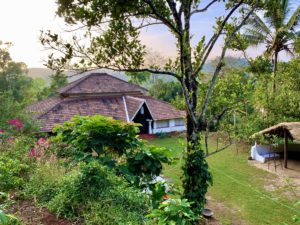
When I first started going to India over twenty years ago, there were fewer students and the general manner both inside and outside the shala was relaxed and easy-going. The last decade has seen so much transformation and this echoes what has been happening socio-politically. India has changed considerably since the millennium and it seems as though it has embraced many of the less attractive aspects of the West and lost much of what makes India great. India can be bewitching and the light, colours, nature, aromas, fruit, vegetables, tea, coffee, spices and wildlife are truly spectacular. So are the traditional crafts, art, classical music, dance, architecture and smiles. This is the India I love and is what inspired me to create a stunning homestay yoga retreat in the hills of the Western Ghats. An exquisite space in nature, where practitioners from all over the world, of all levels, can feel connected and embrace the gift of Ashtanga yoga without distraction.
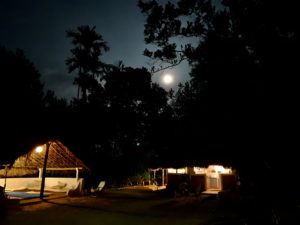
It’s been six years since our first retreat at NIRVRTA and we’ve welcomed nearly three hundred guests to our little piece of paradise. It has been a fascinating journey and not without its challenges and surprises (many of which I’ve shared in part 1). Most recent incidents include Saroja smothering our exquisite antique wooden pillars with garish paint and accidentally setting alight the beautiful thatched roof of our outdoor kitchen. The latter apparently, in a misguided attempt to ‘smoke out’ a hornets’ nest. I too was able to take centre stage when demonstrating my snake-catching skills, whilst clad only in a towel!
Wallowing in the tub one evening, I heard a guest excitedly call my name, or perhaps she was saying ‘Kaa’ (as in the python from Jungle Book). Anyway, I leapt out of the bath and hopped towards the living room, where to my surprise a rather splendid snake had graced us with its presence. Pretending to be calm and collected I reached for the nearest snake-catcher and swiftly wielded the enormous scissor-like gadget in front of me. Revealing my lack of experience, I clasped Kaa in the middle of his spine, but thankfully he didn’t manage to strike or send me into a silent slumber with a rendition of ‘Trust in Me’. I did however succeed in coaxing him into a cardboard box, before freeing him on the coffee estate next to ours. Actually he was just a friendly grass snake and we haven’t seen any other characters from Jungle Book since.
After a long spell of international teaching, I arrived back at the retreat and Saroja had decided to welcome me with decadent aplomb. She had bought a can of turmeric-yellow paint and merrily coated our beautiful hand-carved antique wooden pillars at the front of the house. Fighting back the tears of horror, I realised that for many locals, bright and gaudy is actually delightful. Of course she might have been thinking that the layer of glossy paint would protect the wooden pillars from the elements during the monsoon? I gingerly repainted them (now they have a more subtle distressed-white look) and Saroja went on to display her proud sense of ownership, by varnishing our beautiful red stone, carved Ganesh statue.
It’s amazing how you learn to choose your battles and are incredibly grateful when things actually work out (usually not as expected). When far away from modern urban culture (where we take things for granted), you soon adapt and appreciate what is truly important in life: to have a roof over your head and appropriate clothes; to have running water and enough electricity to pump said water and to power essential devises; to have good sanitation and levels of hygiene; to have gas for cooking; to be able to grow your own food and buy staples locally; to be near reliable public transport; to have access to basic medical care; to earn enough money to live on and have a decent standard of living; to have 4G on your phone without having to walk too far; to have good friends to talk to (even if it’s over WhatsApp or FaceTime); to not waste resources; to feel connected and in tune with nature and to keep yourself healthy, happy, content and safe.
Just a few months into this decade, never has the expression ‘expect the unexpected’ been so resonant. I couldn’t have imagined a dozen policemen threatening us for not having informed the authorities that we were harbouring foreigners with Covid-19, on our beautiful coffee estate in the hills. We weren’t of course and our guests didn’t have the virus, but clearly someone wanted to make trouble. We told the head honcho to call a doctor and check everyone. Instead, an ambulance appeared and taxied all Westerners to a hospital two hours away. Despite everyone testing negative, we were still quarantined at the retreat for fourteen days. No one was allowed to leave to buy food, gas, drinking water or supplies.
Modi’s right-wing citizenship bill was already causing tension, riots and worse. The mob mentality is terrifying and people aren’t afraid to intimidate. Our quarantine ended on 21st March and Modi suddenly announced an all India lockdown and curfew starting in a few hours. No one was permitted to leave their homes (for any reason) and who knows for how long. Thankfully our guests managed to fly out of India safely and I had some business to attend to at the law court in Bangalore. However, I was met with such aggressive hostility from the door/security people (who believed that because I am white, I must have Covid-19), that despite my barrister showing the court-guards (and a picket of supposed medics) my covid-negative certificate, their illuminated response was ‘she is foreign, she carries the virus’. They then formed a mob around me and shouted, waving their fists until I broke and left. The barrister took me to a car park where I signed various documents. Outside the courthouse the (now) hysterical door people created such a monumental fuss, that I was told to come back in a year. The whole debacle was rather surreal, especially having to execute life-changing directives in a car park. Now as I reflect, the bizarre incident seems befittingly poetic.
I headed back to Blighty via Dubai, as India closed its doors to foreigners and embarked on its country-wide lockdown. The pandemic was affecting the whole world now and after landing at Heathrow, I went straight to my parents’ place in Norfolk, to spend the best part of the next 18 months caring for them as covid took hold in the UK.
My life changed beyond recognition. The beautiful retreat in India became a distant memory. I was now staying in the sticks in rainy and cold Norfolk (where I’m not even from), with two nonagenarians and an incontinent dog. Not being permitted to travel, or indeed leave the house apart from grocery shopping, medical emergencies and a daily walk, I began teaching my international students online. Weekday one-to-ones and Saturday Sanskrit-counted Primary, Intermediate and Advanced A Series Ashtanga yoga classes became my lifeline during the pandemic. I felt blessed to be able to teach and see my students regularly, albeit via Zoom from my parents’ conservatory.
Now that much time has passed and we have adapted to this new way of living, the world is slowly opening up again. We are at last able to travel and I am blessed to be able to teach all levels of practitioners online and in person in London and on retreats and workshops internationally.
I will always think fondly of our beautiful homestay retreat in the hills of South India and shall cherish the joyful times there. To live and fully experience a culture that is so different from of one’s own is both enriching and testing. I’ve come to realise that what creates happiness is balance, peace, health, simplicity and connection. When I think of India now, my heart goes immediately to the magical aspects. Memories of the darkest days fade and the happy times remain.
‘It is only when the mind is free from the old, that it meets everything anew and in that, there is joy.’ Jiddu Krishnamurti
© 2021 Philippa Asher