Beginning Ashtanga Yoga
Ashtanga asana for new practitioners and beyond!
by Philippa Asher
 Please note, I am not using diacrital marks for Sanskrit terms that have been transliterated from Devanagari to Roman script, but rather showing a phonetic pronounciation
We’re currently in lockdown, due to the coronavirus pandemic. What a great opportunity to begin learning about, studying and practising yoga! As our regular sport, fitness and asana classes in gyms, shalas, studios and on retreats are on hold, many trusted practitioners/teachers have found new ways to share their knowledge and skills, by offering online classes. Others are using the downtime as a chance to really focus on their craft and self-practice. I have spent lockdown teaching Led Intermediate Series, Led Primary Series, Pranayama and One-to-One Ashtanga yoga lessons online, to practitioners all over the world. This is something I would never have imagined doing a year ago (click here for a glimpse!)
Being able to practise yoga quietly, as focused, self-sufficient and undistracted practitioners, is of course what we’re aiming for. Obviously though, until we have a solid grasp (physically, mentally and energetically) of what we’re meant to be doing and how, practising on ones own without guidance, can be both challenging and daunting. Possibly one of the hardest things of all, is to actually start and not give up.
For those who are completely new to breathing slowly, focusing the mind and gentle stretching, I have made this short sequence:

When comfortable with regularly practising the above, you will be ready to slowly and systematically begin learning the Ashtanga asana method.
Full Ashtanga Primary Series (with asana names and counts):
So yoga is a state of mind, a state of stillness, peace, of higher conscious awareness. The state of yoga can happen when the fluctuations of the mind cease, when it is quiet and calm. When the mind is distracted, agitated or stupefied it is in a non-yogic state and when it is focused and eventually still, it is moving towards the state of yoga. As well as pandering to our human emotions/afflictions (such as desire, anger, greed, delusion, arrogance, jealousy, fear, ignorance, attachment, aversion and self-importance), other things that can cause the mind to be disturbed might be creating imaginary scenarios in our head; dreams/nightmares; misremembering a situation or indeed remembering it correctly (and re-living it); reacting to incorrect information, or indeed to correct information. Having things on our mind can make us anxious or preoccupied and this can lead to mental dis-ease, disturbance, physical and emotional pain. Our energetic/nervous system can become imbalanced and our immune system compromised. Most of us are happiest and healthiest when we are not stressed and emotional, so it’s good to cultivate being able to recognise what is causing our mental disturbance and to either do something about it, or to let it go (if we can). This is why hatha and raja yoga are such elegant and powerful tools, as they teach us how to control, strengthen and make space in the mind, the body and the breath and to attain optimum mental, physical and emotional health.
For many of us, the access point for learning how to control the mind and to train it to become mentally unencumbered and quiet, is to master how to control, open, strengthen, balance and clean the body, the nervous system and the breath. Not all of us are actually 'connected' to our physical bodies, so when we practise yoga postures (asana), we develop awareness and become strong, flexible, focused and healthy. We cultivate how to be present and to find inner peace, strength and openness. Back in the day, a student would learn hatha and raja yoga directly from their guru/teacher, without distraction. Group yoga sessions are a modern invention (from the 1930s) and by their very nature, invite distraction. This can be exacerbated if a class attempts to busy the mind and stimulate the senses (which might be good for something, but probably not the continued practise of yoga). One of the highly attractive aspects of a class situation, is that you’re there to receive excellent personal guidance and can’t check your phone or rustle up a quick snack.
The postural practice (with controlled breathing and concentration) is a psycho/physical discipline that helps us attain a one pointed focus, strength, flexibility, courage, resilience, determination and balance through controlling the mind, the body and the breath. In the Ashtanga asana system, by mastering one posture at a time, in sequential order with steadiness, strength, flexibility, stability, joy, effortlessness, focus and balance, we keep challenging the mind, the body and the breath to become more steady and strong as the postures become progressively more complicated and testing. With repetition of the same asana sequence, the muscle memory kicks in (so that we no longer need to think about what we are doing) and the body, breath and focus point become synchronised and at ease. The practice becomes a moving meditation.
There are a couple of concepts that when understood, absorbed and practised effectively, help us along the way. The first is tristhana (the three places of attention) which is revealed when the breath, gaze point and movement/posture are perfectly aligned. In the Ashtanga asana system, continuous long slow inhalations and exhalations are made through the nose (keeping the mouth closed). This calms the mind, slows the breathing and heart rate and heats/relaxes the body. When combined with the postural practice, muscles soften, lengthen, are strengthened and toxins are removed through sweat. Movements that go upwards happen on an inhale and those that go downwards on an exhale. The moving and breathing are connected and synergised. Bandhas (energetic locks) help to control the breath and prana (vital energy) as it moves around the nervous, circulatory and respiratory systems (from the muladhara/root chakra, towards the sahasrara/crown chakra, along the central sushumna nadi of the nervous/energetic system). Mula bandha or the root lock (when we engage and release the muscles of the pelvic floor), keeps us grounded in the practice; uddiyana bandha or the abdomen lock, is activated when the muscles around the diaphragm are sucked in at the end of each exhale (giving us power in the practice) and jalandhara bandha (the throat lock, triggered when the chin connects with the suprasternal notch), regulates the circulatory and respiratory systems. When all three locks are engaged simultaneously in maha bandha, the endocrine system is said to be regulated.
The asana sequencing is designed to align, strengthen, open and clean the body, remove toxins and free blockages. Safe physical alignment, along with perfect synchronisation of the breath and focus points, allows prana to move freely around the physical and energetic bodies, eliminating dis-ease (and thus disease). When the practice starts to feel steady and stable and the postures are executed with slow controlled breathing, seem effortless, are focused and balanced (mentally, physically, emotionally, energetically: between the parasympathetic and sympathetic nervous systems) the asanas begin to reveal themselves. When this happens the practice and the precise order of the asana sequence begins to make sense, as the practitioner gains an understanding of the essence of each posture and the stillness attained when in the state of an asana.
To enhance concentration, specific gaze-points (drishti) are used so that the mind cannot wander and the postures can reach a state of steadiness, calm and stillness. Each posture in the Ashtanga asana system has its own drishti eg:
urdhva mukha svanasana upward facing dog pose is towards the nose (nasagre)
adho mukha svanasana downward facing dog pose is towards the navel (nabhou)
yoganidrasana yogic sleep pose is third eye (bhrumadhye)
utkatasana fierce posture is thumbs (angusthagre)
virabhadrasana b warrior pose is middle finger (hastagre)
ubhaya padangusthasana both big toes pose is up (urdhva)
maricasana c first side sage Marici pose is right side (parshva)
utthitahasta padangusthasana b first side upright hand to big toe pose is left side (parshva)
paschimattanasana intense back stretch is toes (padagre)
A further device to help focus the mind, keep the movements precise and allow them to work efficiently with the breath is the concept of vinyasa. Vinyasa is to do with precise placement and in this context involves bringing the mantra (or Sanskrit counts) into the mind and placing/linking them precisely with each movement. In the Ashtanga asana system vinyasa is presented as elegant Sanskrit-counted moving/breathing sequences that link postures together, based on suryanamaskara a. We count in Sanskrit, the changes in movement from samasthitih, through to the state of the asana and then from the exit out. When in the state of the asana, we count in our own language for the duration of which the posture is being held. This might be for five, ten or more counts.
For example suryanamaskara a has nine vinyasas (precise changes in movement). We count from samasthitih through to the state of the asana in Sanskrit (ie until adho mukha svanasana), as we hold the posture steady we count for instance in English, then as we move out of adho mukha svanasana to uttanasana and beyond, we count again in Sanskrit.
exhale [samasthiti equal/balanced standing pose]
ekam (1) inhale [urdhva vrikshasana upward tree pose]
dve (2) exhale [uttanasana a stretched forward pose]
trini (3) inhale [uttanasana b]
chatvari (4) exhale [caturanga dandasana four limbed staff pose]
pancha (5) inhale [urdhva mukha svanasana]
shat (6) exhale [adho mukha svanasana] one, two, three, four, five slow counts: one count = one slow inhalation and exhalation (of equal lengths)
sapta (7) inhale [uttanasana b]
ashtau (8) exhale [uttanasana a]
nava (9) inhale [urdhva vrikshasana]
exhale [samasthiti]
Full vinyasa uses the first six counts of suryanamaskara a and then on sapta (count 7), the state of the asana is taken eg: from samasthitih to utkatasana
Half vinyasa uses the middle section of suryanamaskara a (from chaturanga dandasana to adho mukha svanasana). The next posture (or second side) is then executed on the following count eg: between utkatasana and virabhadrasana a
When we understand and feel the essence of each posture within the context of its sequence, harmonising tristhana and vinyasa, the mind becomes still. The practice requires a tremendous amount of continued effort, discipline, focus, determination and dedication. We have to find the strength, resilience, balance, grace and willpower within us, to make the seemingly impossible become achievable and effortless. Yoga is state of mind that can be cultivated when we cease dancing with chaos, agitation, destruction, distraction and fear.
So to summarise, in the Ashtanga asana system we’re trying to: synchronise moving, breathing and gazing; have safe physical alignment in the postures; master each asana sequentially with equal levels of strength, flexibility, grace and focus; feel a state of inner peace, balance, stillness and calm.
So let us begin …
The above and below filmed workshops (Part 1 and Part 2) focus on technique, execution of, safe alignment, tristhana and vinyasa for:
samasthitih
suryanamaskara a, b sun salutation a, b
Standing Sequence:
padangushthasana hand (holding) toe posture
padahastasana hand (holding) foot posture
utthita trikonasana a/b upright extended triangle posture/revolved (parivritta)
utthita parsvakonasana a/b upright extended side-angled posture/revolved (parivritta)
prasarita padottanasana a, b, c, d wide-stance forward stretch posture
parshvottanasana intense side stretch posture
utthitahasta padangusthasana a/b upright hand to big toe posture
ardhabaddha padmottanasana half bound lotus stretch posture
utkatasana fierce posture
virabhadrasana a/b warrior pose
full vinyasa, half vinyasa, jump through, jump back
Finishing Sequence (last three postures):
baddhapadmasana and yogamudra bound lotus pose and yoga seal/gesture
padmasana with jnana mudra lotus pose with hand gesture of knowledge
utpluthi uprooted pose
concepts of the Ashtanga asana method, what is yoga and why practise
Part 3 (below) aims to demonstrate the full expression of the above postures (within the context of their vinyasa), practised with the Sanskrit count (as they would be performed during self-practice). The film can be used to practise along to, rather like a Sanskrit-counted led class (where practitioners can familiarise themselves with the exact sequence, the name of each asana and its precise vinyasa/counts):
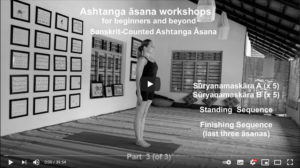
The above practice should give a solid foundation, as well as being a good introduction to Ashtanga yoga and is in itself, a beautiful daily practice. The key is quality, rather than quantity of asana. With any posture and vinyasa that is challenging, it’s worthwhile repeating the sequence two or three times (focusing on good alignment, technique and the perfect synchronisation of breath, gaze point and movement). By the third time, it should begin to feel more stable and comfortable.
Some may wish to go on to systematically learn a few of the Primary Series postures within their respective vinyasa, followed by Backbends and the rest of the Finishing Sequence
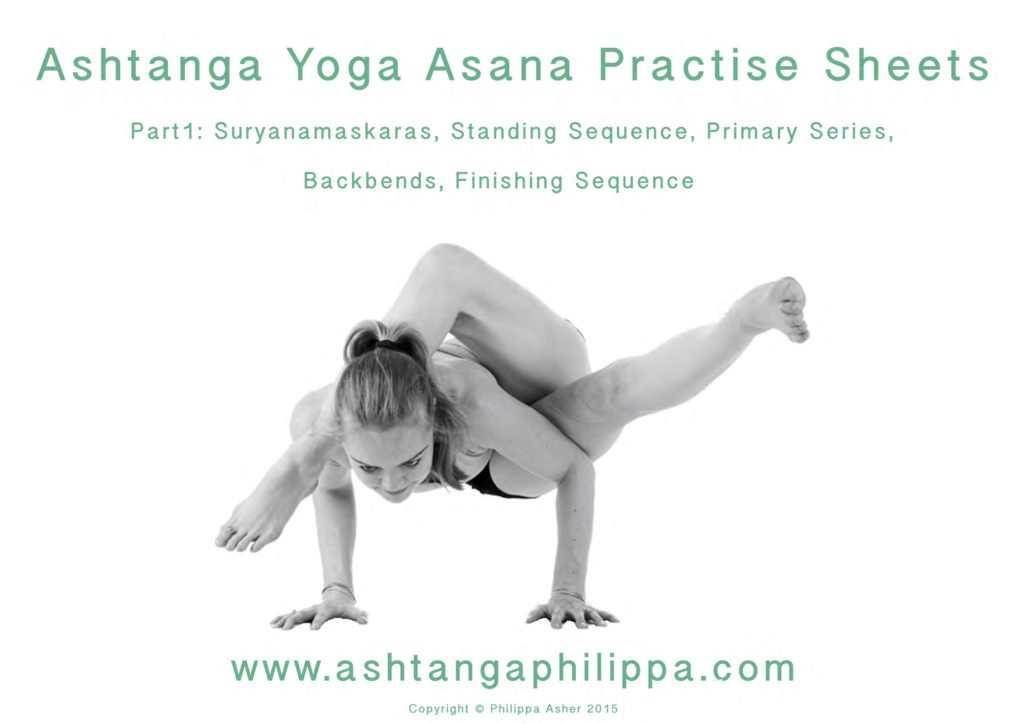
Ashtanga Yoga Asana Practise Sheets Part 1 (below) includes all of the Primary Series postures, as well as the Standing Sequence, Backbends and Finishing Sequence and more information on suryanamaskara a, b and vinyasa:
The practice should aim to be quiet and understated. It’s conducive to practise with an empty stomach (and ideally a calm mind). Clothes that are easy to move in are best and if you are practising with others, modest attire is befitting. A thick non-slip yoga mat that is both wide and long enough is highly recommended and a sweat towel is also handy. A clutter-free quiet space with natural light and good ventilation is ideal and the optimum time of day for practising will really depend on the individual’s personal schedule. Although it is immensely beneficial at whatever time is possible, it’s great to practise before the chaos of daily life commences (so as to reconnect with the tools and state of mind that will help elegantly deal with whatever presents itself). Ultimately practising five days a week is optimal, but most people take a while to build up to two or three. The trick is to just start and see what happens!
For more information about Ashtanga yoga:
ashtangaphilippa.com/ashtanga-yoga
For Philippa's studio and retreat teaching schedule:
ashtangaphilippa.com/ashtanga-yoga-classes-retreats-workshops